

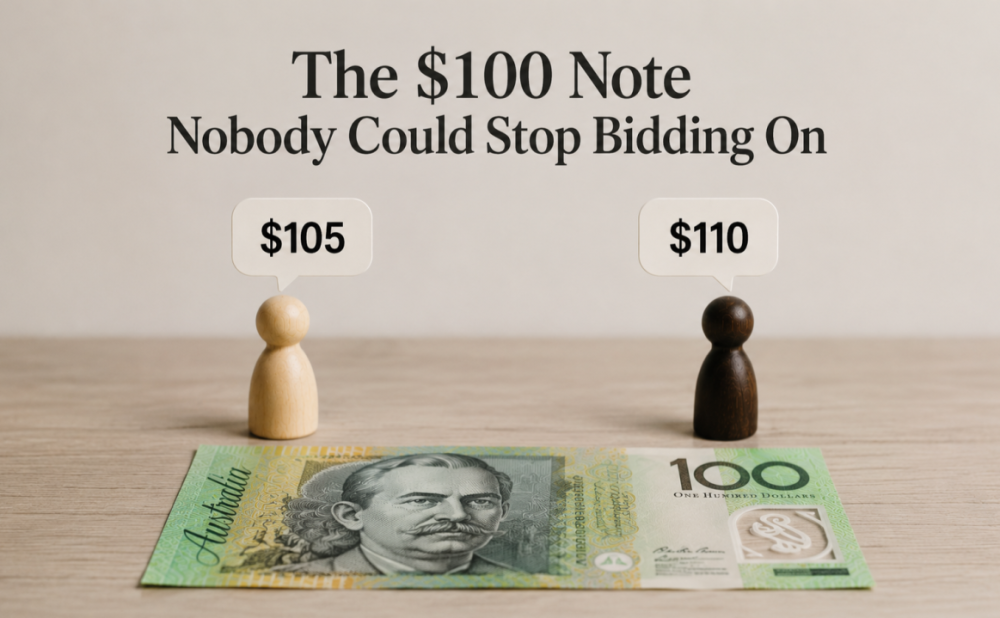
A Harvard economist named Martin Shubik used to run a game in his classes. He’d pull out a $100 bill and auction it off, with one rule bolted on: the highest bidder wins the $100, but the second-highest bidder also has to pay their bid — and gets nothing for it.
Bidding starts small. $5, $10, $20. It’s free money, after all, and everyone’s happy to bid a little for a shot at it.
Then it gets interesting. As bidding climbs past $60 or $70, the room thins out until only two bidders remain. And this is where the game turns strange. Say the bids are sitting at $95 and $90. The $90 bidder is facing a decision: stop now and lose $90 for nothing, or bid $100 and, at worst, break even.
They bid $100.
Now the other bidder is staring at a $95 loss if they stop. So they bid $105 — a guaranteed loss, but a smaller one than walking away.
Round and round it goes. Shubik documented auctions that finished well north of $200. The experiment has been repeated countless times over the decades, in classrooms and boardrooms, with remarkably similar results. Two intelligent, well-trained people, competing to lose the least amount of money on a $100 bill, end up losing far more than the bill was ever worth.
Nobody in that room set out to be irrational. Each bid, in isolation, was the smaller loss available at that moment. That’s the trap. It’s never one bad decision; it’s a long chain of decisions that were each individually reasonable and collectively ruinous.
This is an escalation of commitment, and it isn’t confined to a classroom game.
I’ve seen a version of this constantly — first as a litigator, now from the other side of the table, in mediation.
Litigation can feel remarkably similar.
A party has spent months gathering evidence. Experts have been retained. Witnesses have been interviewed. Barristers have prepared advice. Hundreds of thousands of dollars may already have been spent.
By the time mediation arrives, the future can become overshadowed by the past. Settlement no longer feels like a commercial decision. It feels like surrender.
“We’ve already spent this much.” “We’re too close to trial.” “We’ve come this far.” “We can’t walk away now.”
But none of those reasons changes the value of the claim. They only describe the cost of getting there.
The instinctive question in the room becomes: how do we avoid losing what we’ve already put in? That question has no ceiling. There is always one more bid that feels smaller than walking away.
The useful question is: if I were starting today, knowing only what I know now, would I choose this course? Every dollar spent before this morning is gone, whether the case settles today or runs for another year. It cannot be recovered by fighting longer. It can only be added to.
None of this means giving up easily, or treating every hard fight as a mistake. Some cases are worth running to the end on the merits. The problem isn’t persistence. The problem is persistence that has quietly stopped being about the case and started being about not wanting to have lost the money already spent getting here.
The bidders who lost the most in Shubik’s auctions weren’t the ones who bid recklessly early on. They were the ones who couldn’t bring themselves to stop.
The real cost was never losing. It was spending more to avoid admitting they already had.
If this article resonated with you, feel free to connect with me on LinkedIn. I regularly write about mediation, negotiation psychology and decision-making in litigation.