

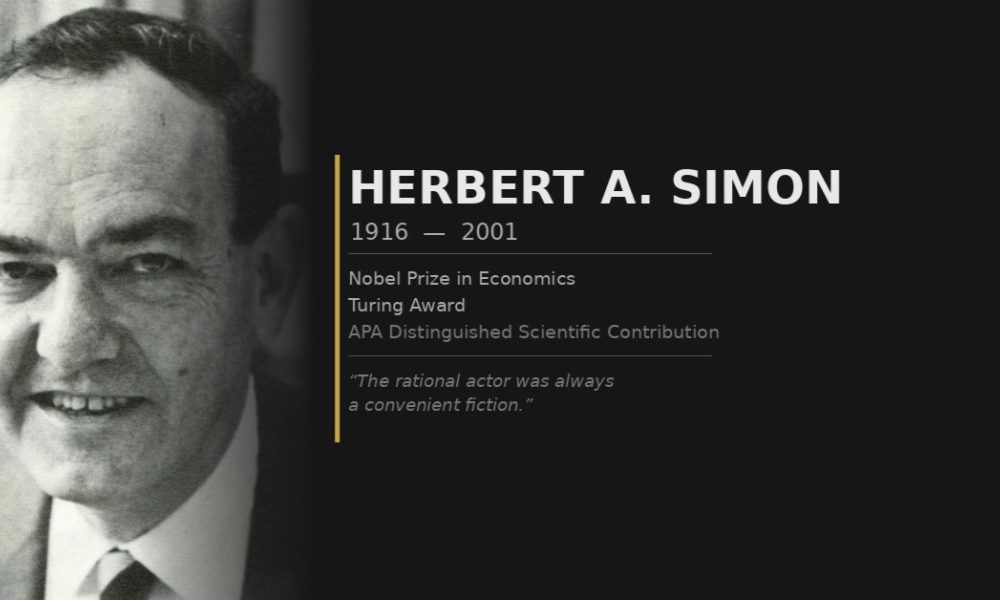
He also won the Turing Award — computer science’s highest honour. He wasn’t really a computer scientist either.
Simon collected the prestigious prizes across three separate fields because he was always working on the same problem. He just kept finding it in different places.
Born in Milwaukee in 1916, Simon trained as a political scientist. His 1947 book Administrative Behavior changed how organisations understood their own decision-making, how authority actually functions, how choices get made inside bureaucracies, and why the textbook version of rational management rarely matches what happens in practice.
From there, he moved into psychology, then into what would become computer science. In 1956, with Allen Newell and Cliff Shaw, he helped build the Logic Theorist — one of the earliest working AI programs. The Turing Award followed in 1975. The Nobel came three years later.
When asked to account for the breadth of his work, Simon simply said he was always studying human decision-making.
His central argument was that the rational actor model — the idea that people survey all available options and choose the best one — doesn’t describe how decisions actually get made. We have incomplete information. We have competing motivations. We have real cognitive limits. Full evaluation, in most situations, is simply not possible.
So instead of optimising, we satisfice. Simon coined the word himself: a blend of satisfy and suffice. We find an option that’s good enough, and we stop there.
I’ve written previously about what satisficing looks like in a mediation room here.
Robert Cialdini’s research in Influence maps this territory from a different angle. His argument is that when a particular cue is present, people often respond automatically — bypassing deliberation entirely. Not because they’re irrational. Because deliberating every decision from scratch is simply not how the mind works.
Anchoring is one well-documented example of this in a negotiation context.
Anchors work not because they are correct. They work because human beings tend to unconsciously adjust from the first number they encounter.
The first offer placed on the table often shapes the psychological range within which the parties negotiate — even where everybody in the room intellectually understands that the opening position may be ambitious.
A plaintiff may open at $2 million in a case realistically worth somewhere between $400,000 and $600,000. The defendant will reject the figure. The lawyers may privately regard it as unrealistic. Yet the number still shapes the negotiation, because every subsequent offer is assessed against it.
But there is an important practical question that practitioners sometimes overlook: how do you balance anchoring against the need to be taken seriously?
Because if your opening position is completely detached from reality, experienced lawyers and insurers will often stop engaging with the substance of your case and start reacting to the negotiation itself.
And that creates a problem. The mediator is no longer facilitating a conversation about the dispute. They’re spending time trying to pull the parties back to the substantive issues, time that should have been spent moving them toward resolution.
Understanding these dynamics changes how you read a room. It changes the weight you give to the order in which options are presented, to who speaks first, and to what gets framed as a loss versus a gain.
Herbert Simon spent his career studying how people actually make decisions.
Mediators confront the same question every day.
The rational actor was always a convenient fiction.
Resolution becomes easier when we stop negotiating with the person we imagine is sitting across the table and start negotiating with the person who is actually there.